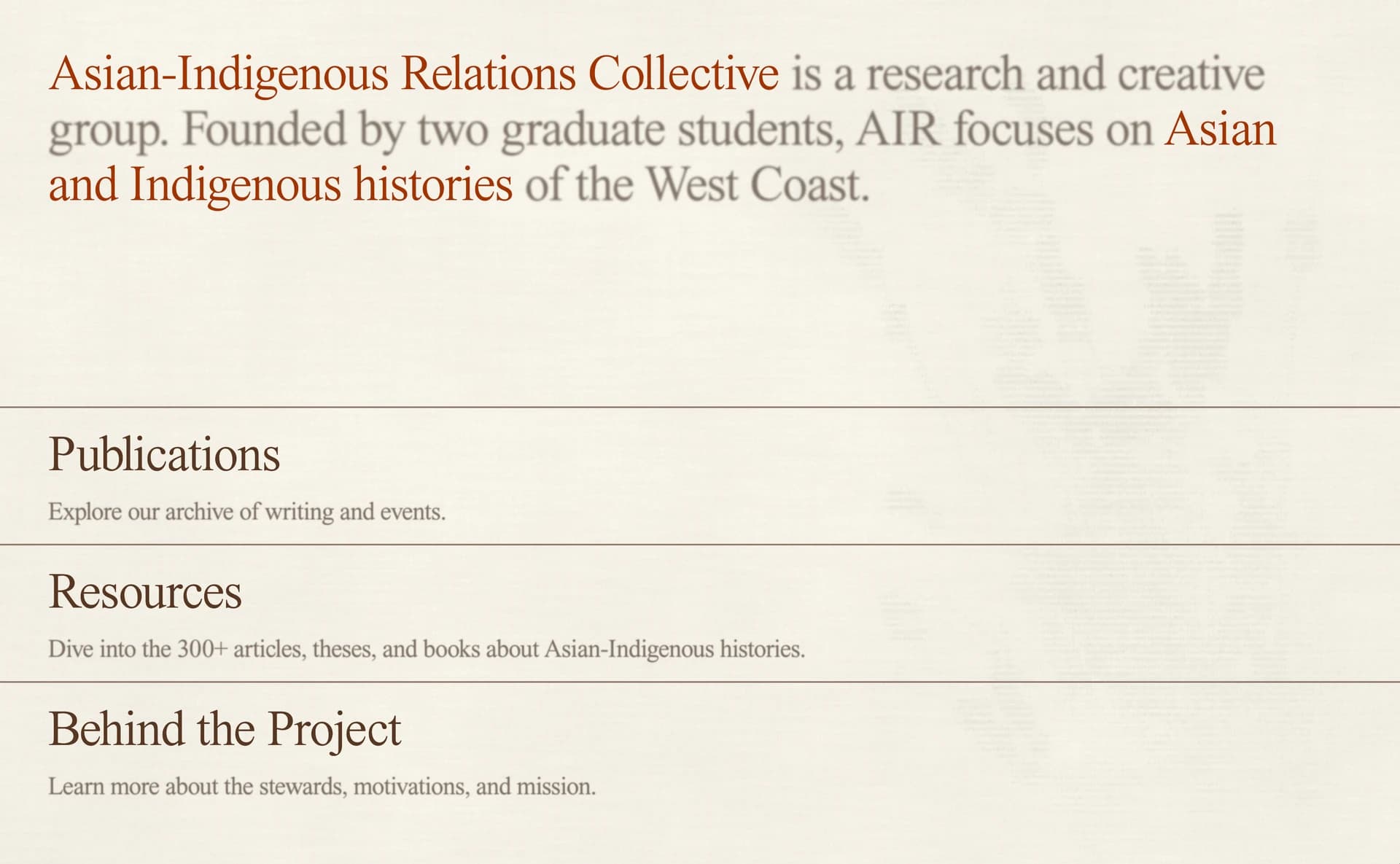
Asian-Indigenous Relations Collective, hereafter referred to as AIR, is a BIPOC-led design and research team based on the unceded səl̓ilw̓ətaʔɬ (Tsleil-Waututh), Sḵwx̱wú7mesh Úxwumixw (Squamish), xʷməθkʷəy̓əm (Musqueam) and kʷikʷəƛ̓əm (Kwikwetlem) Nations. I co-founded the collective alongside SFU graduate students Ty Bryant and Geri Lee.
My role covered brand design, community outreach, grant writing, and design engineering. AIR would not have been able to come to fruition if not for our many collaborators, too many to name here. Notably, I worked closely with Dr. Ayaka Yoshimizu, Dr. Jade Yi Chien Ho, and Dr. Nadine Attewell. It is with their guidance and support that the AIR team was able to accomplish all that we did in our short time together.
Overview
How do we design a digital third space for marginalized communities?
(The contents of this introduction are adapted from this article I co-wrote last year. Feel free to read that in its entirety for an in-depth look at our design process.)
Since the inception of the internet, the digital world has seen countless spaces emerge for a wide variety of communities, from gamers to artists to musicians. It should come as no surprise that marginalized peoples would create their own universes to build relationships and strengthen solidarity.
However, as our digital world continues to expand as a force of globalization, DesignI capitalise “Design” to represent the design industry and all of the whiteness it embodies. has remained implicated in white supremacy and settler colonialism, failing to mirror the diverse ethnic makeup and struggles of the world's marginalized peoplesWang, Jen. ‘Now You See It: Helvetica, Modernism, and the Status Quo of Design’. 2016.Read source ↗.
The implication of Design in the neocolonial movement is something that I had to reckon with while building our brand identity. To quote myself:
AIR’s core mission is to fight for the decolonization and restitution of online and offline colonial spaces. By embracing a design process that is reflective of socio-political contexts and relations that we as a collective are reckoning with, we continue to challenge the status quo of Design, providing a brand and platform that actively welcomes members and communities of colour to be seen and heard in the digital world.
As we wound down operations at the beginning of the summer in 2026, I wanted to reduce our costs and build a small system that could be maintained by me, our solo developer.
Solution
Payload CMS and a small Next.js application
I built a small Next.js application alongside Payload CMS to keep AIR's publications, resources, and network accessible as we wound down operations. The CMS provides a space for our team to manage this content, while the website allows it to remain available to the communities we built AIR for.
Browsing the publications on AIR's website.
Through the dashboard, we can begin a new publication, return to an existing entry, and manage our resources and network members. Users and media are managed within the same workspace. With fewer people available to maintain AIR, I wanted these everyday tasks to remain straightforward for whoever was doing the work.
Research
My first approach was to set up a monorepo for the website and CMS. I spent at least a week trying to make this work before deciding that I did not want to continue pulling my hair out over it. I eventually built two separate repositories, one for the frontend and one for the CMS, with the frontend retrieving content from the database through an API.
Hosting required its own research. I had to do a considerable amount of digging to understand how we could host our website, CMS, and database without spending a dollar. I am a fan of open-source software, so that was a priority from the beginning.
I initially wanted to self-host everything, but the costs would have fallen to me, which would not have been sustainable. I ultimately chose Supabase for our database, Render for our CMS, and Vercel for the main website. AIR is small enough to remain within the free tiers of all three services, so our only ongoing expense is the domain.
Finding a CMS that we could maintain
When researching the CMS itself, I looked for something free and open source that I could host independently and that would work well with Next.js. Our limited budget shaped what was possible, alongside the amount of time I could commit to maintaining the system.
This search led me to Payload. Its integration with Next.js made it a useful fit for the application, and I could build the public website around the visual identity we had developed for AIR.
Choosing a CMS we could afford to keep
As AIR wound down, I wanted to ensure that the work we had done together would remain accessible. Maintaining the website would become my responsibility, so choosing a CMS meant considering both our financial limitations and the work I could reasonably take on as our solo developer.
Payload's core software is free and open source under the MIT license, allowing me to inspect and adapt the code without paying for a CMS subscription. We could choose where to host it and retain control over our database. For a collective with little money, these were practical considerations in keeping our work online.
The absence of a subscription does not remove the work of maintaining a website. Hosting, storage, backups, and updates still need attention, even when the services we use do not currently cost us anything. Choosing Payload gave me more control over how we managed those responsibilities.
Setting up the CMS began with conversations with my team about our content types and what we needed from the database. Together, we worked out how to organize our publications, resources, and network members, alongside the users and media needed to manage them.
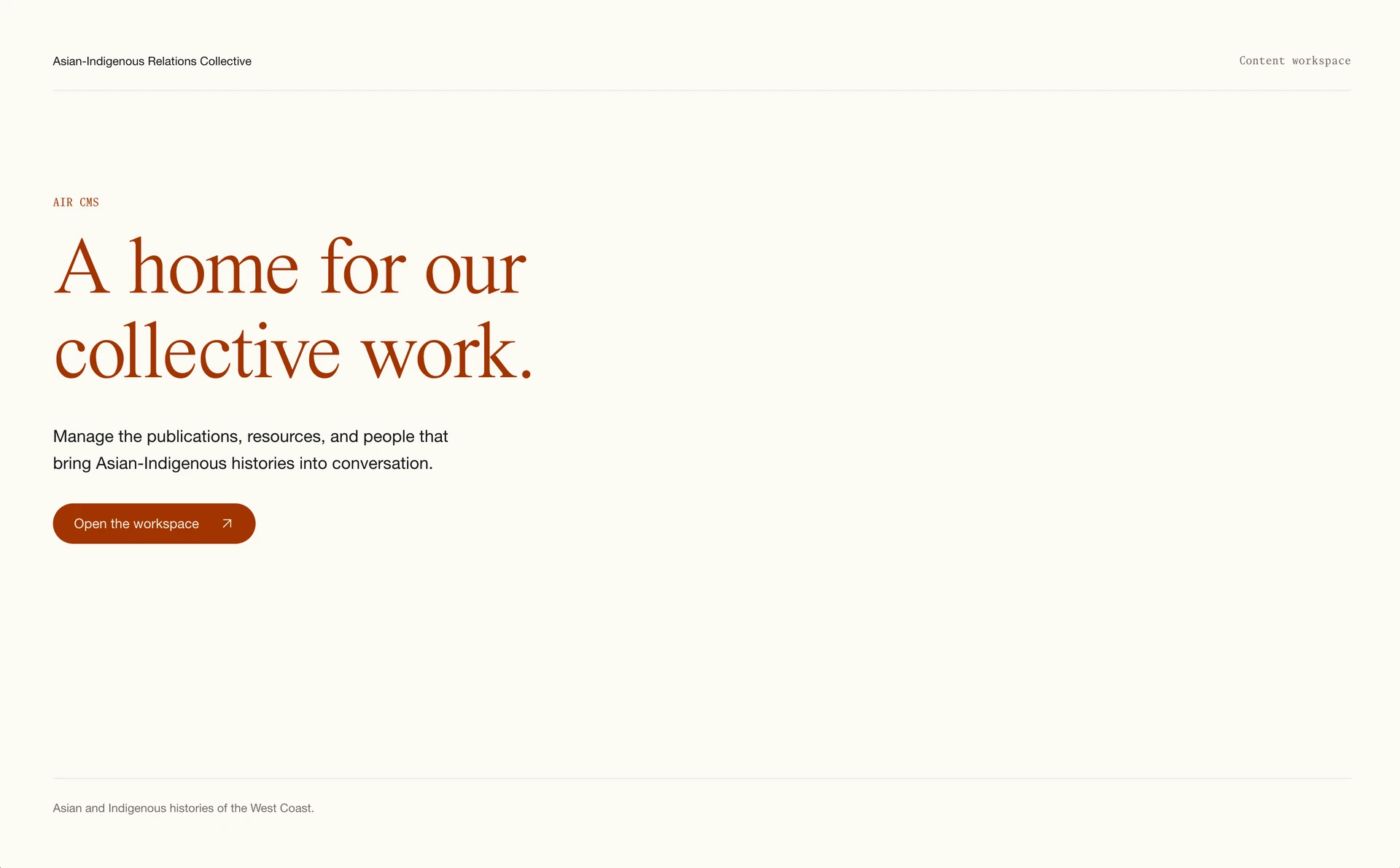
The entry point to AIR's content workspace.
Setting up Payload for AIR
I translated these content types into collections in Payload. Defining their fields in code provided the corresponding tools for editing and managing the content, giving me a foundation to work from without building an entire administration system myself.
The dashboard brings these collections together, showing recently edited publications and their publication status, with a direct way to begin a new entry.
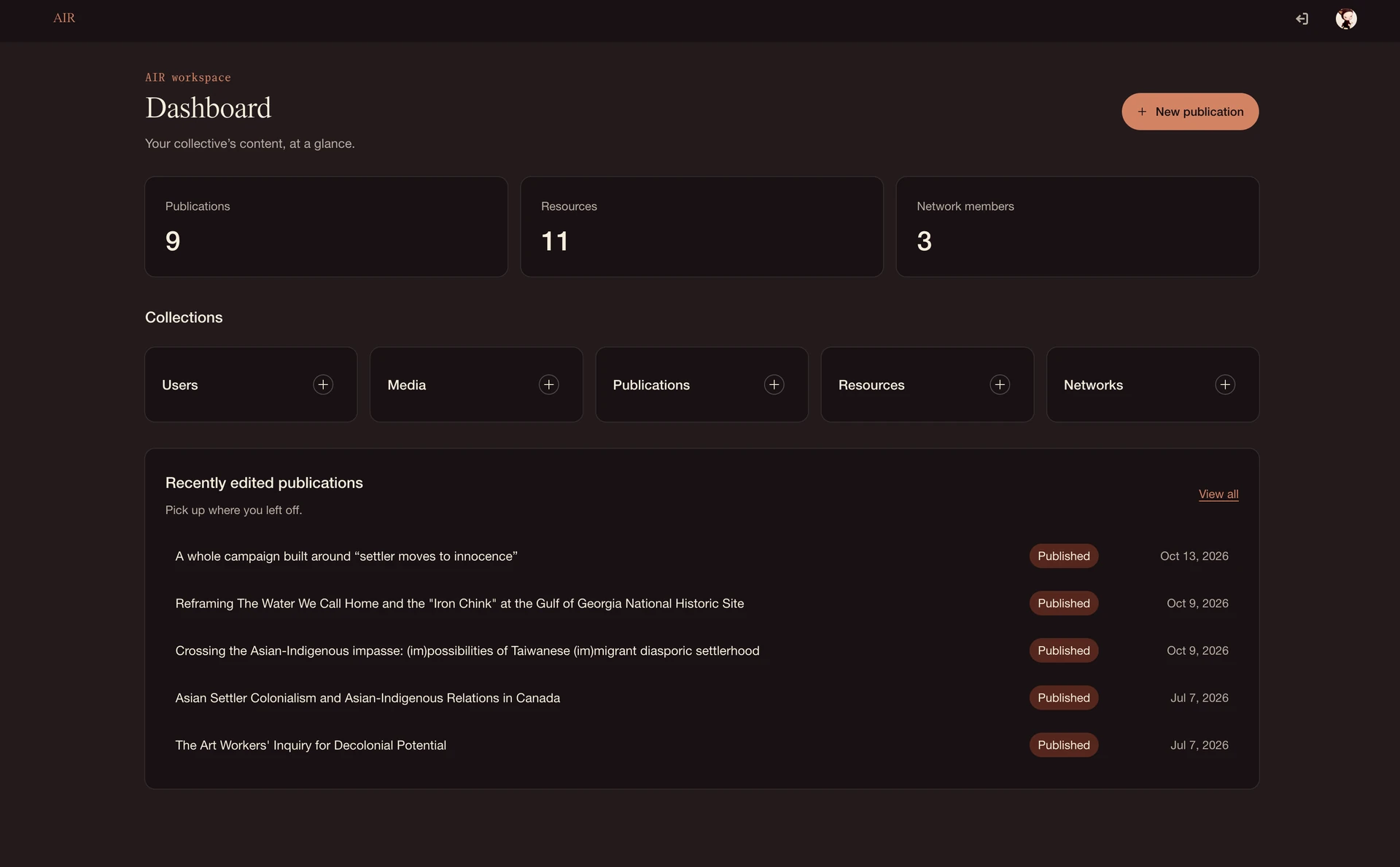
The dashboard and collections we use to manage AIR's content.
Our database is hosted on Supabase. During the early stages of development, I accidentally deleted it and had to re-enter everything by hand. Afterwards, I wrote myself a very long note about never deleting Supabase tables again.
Reflections
Generally, I am proud of what I've been able to produce for AIR. We held a three-day symposium, got invited to speak at conferences, design workshops, and give guest lectures at the University of British Columbia and Simon Fraser University.
The website is a continuation of the on-the-ground work I've done: intentional, focused, and critical. It feels like a tiny part of my life where I don't need to worry about staying up-to-date with design trends. I can just build a place where our communities can feel comfortable.